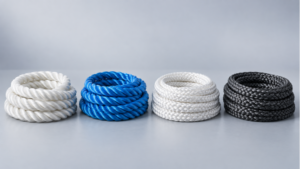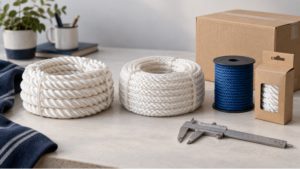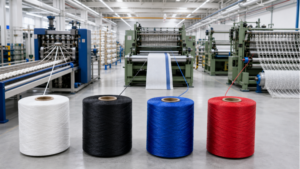
For rope, webbing, netting, and industrial textile manufacturers, sourcing polypropylene yarn is not only about asking for a denier and a price. Buyers also need to confirm tenacity, breaking force, elongation, twist, intermingling, color, package weight, unwinding performance, UV requirements, and batch consistency.
High tenacity PP yarn can look similar across suppliers, but the final performance may be very different. A yarn with the correct nominal denier can still cause rope strength variation, webbing defects, unstable weaving, color mismatch, or production downtime if the actual linear density, strength, winding, or yarn structure is inconsistent.
This guide explains how to evaluate 600D-3000D high tenacity polypropylene multifilament yarn and how Shandong Okay Rope Net Co., Ltd. supports factory customers with specification matching, sample confirmation, production communication, packing, and export supply.
What Is High Tenacity PP Multifilament Yarn?
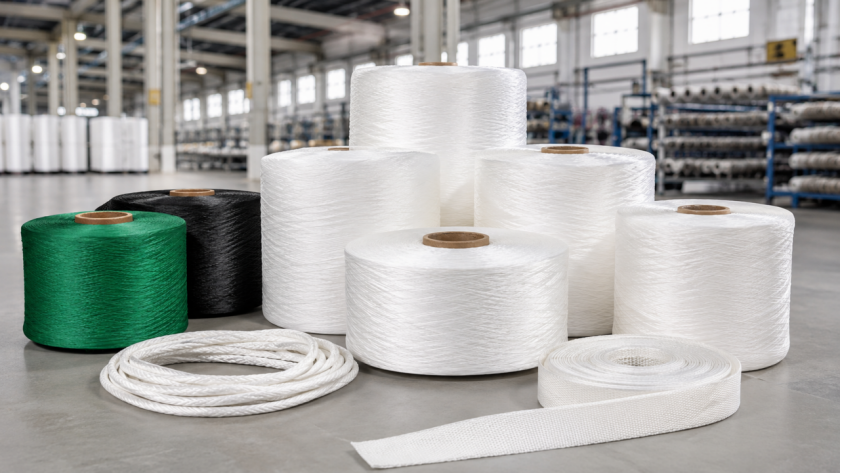
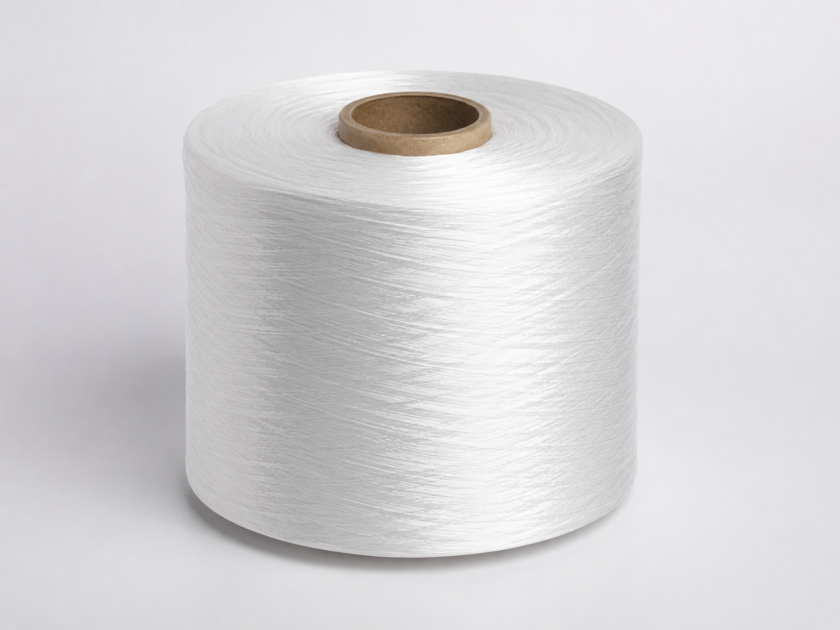
PP multifilament yarn is a continuous-filament yarn made from polypropylene. According to BISFA terminology, a multifilament yarn is a filament yarn consisting of two or more filaments. BISFA also defines tenacity as force divided by linear density. This is why yarn strength is commonly compared in units such as g/den or cN/tex instead of only by total breaking force.
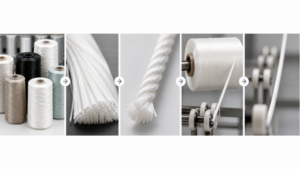
The yarn is produced by melting polypropylene, forming multiple continuous filaments, drawing them to orient the polymer structure, applying the required finish, and winding the yarn onto packages. Depending on the intended downstream process, the yarn may be supplied as regular untwisted yarn, air-intermingled yarn, or twisted yarn.
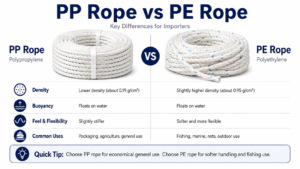
From a material perspective, the British Plastics Federation lists polypropylene at a density of about 0.905 g/cm³ and a maximum continuous-use temperature of about 80°C. It also rates resistance to dilute acids, dilute alkalis, and alcohols as very good. These properties help explain why polypropylene yarn is lightweight and useful in rope, netting, packaging, and other industrial applications, although actual outdoor performance still depends on the grade, additives, color, finish, and final product construction.
For OKAY Rope & Net products, the usual high-tenacity target is at least 6.5 g/den for white yarn and at least 5.5 g/den for colored yarn. Using the BISFA conversion factor, these values are approximately 57.4 cN/tex and 48.6 cN/tex respectively. These are product targets for quotation and batch confirmation, not universal values for every polypropylene yarn on the market.
What Does 600D-3000D Mean?
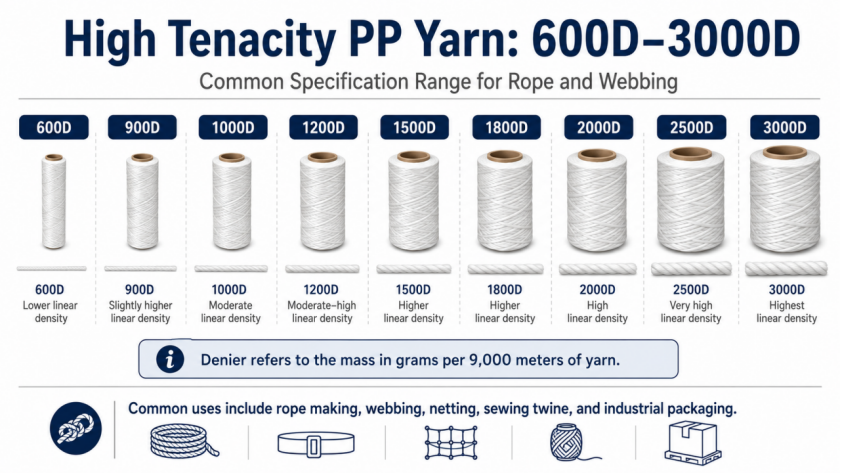
Denier is a linear-density unit used to describe yarn size. BISFA lists 1 denier as approximately 0.111 tex, while 1 tex equals 1 gram per 1,000 metres. Therefore, a 1,000D yarn has a theoretical mass of about 111.1 grams per 1,000 metres, before considering testing tolerance and commercial allowance.
The official ISO 2060 yarn linear-density method describes determination of yarn linear density by the skein method. For buyers, this matters because the quoted denier should be checked by mass per unit length rather than judged by visual thickness alone.
| Nominal Denier | Approx. Tex | Theoretical Mass | Typical Selection Direction |
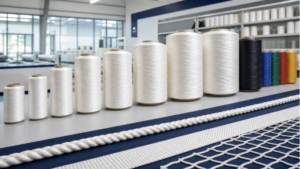
| 600D | 66.7 tex | About 66.7 g per 1,000 m | Fine rope/twine components, lighter webbing or technical thread, depending on construction |
| 800D | 88.9 tex | About 88.9 g per 1,000 m | Fine-to-medium rope, webbing, netting and sewing applications |
| 1000D | 111.1 tex | About 111.1 g per 1,000 m | General rope, webbing and net production |
| 1500D | 166.7 tex | About 166.7 g per 1,000 m | Medium rope, industrial webbing and netting |
| 2000D | 222.2 tex | About 222.2 g per 1,000 m | Heavier rope, webbing and industrial textile structures |
| 3000D | 333.3 tex | About 333.3 g per 1,000 m | Heavy yarn bundles for rope, webbing or net structures requiring higher yarn size |
Buyer note: Denier describes yarn mass per unit length, not the finished rope diameter and not the breaking strength by itself. Two 1,000D yarns can have different tenacity, elongation, filament count, finish, twist, color, or winding quality.
Typical OKAY PP Yarn Supply Range
| Specification Item | Typical OKAY Supply Information |
| Nominal range | 600D-3000D |
| Yarn forms | Regular/untwisted, air-intermingled, and twisted yarn |
| White yarn tenacity target | At least 6.5 g/den (about 57.4 cN/tex) |
| Colored yarn tenacity target | At least 5.5 g/den (about 48.6 cN/tex) |
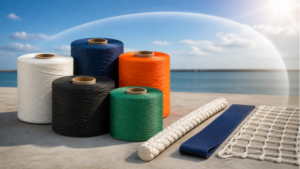
| Common colors | White, black, red, yellow, blue, green, orange and gray; custom matching can be discussed |
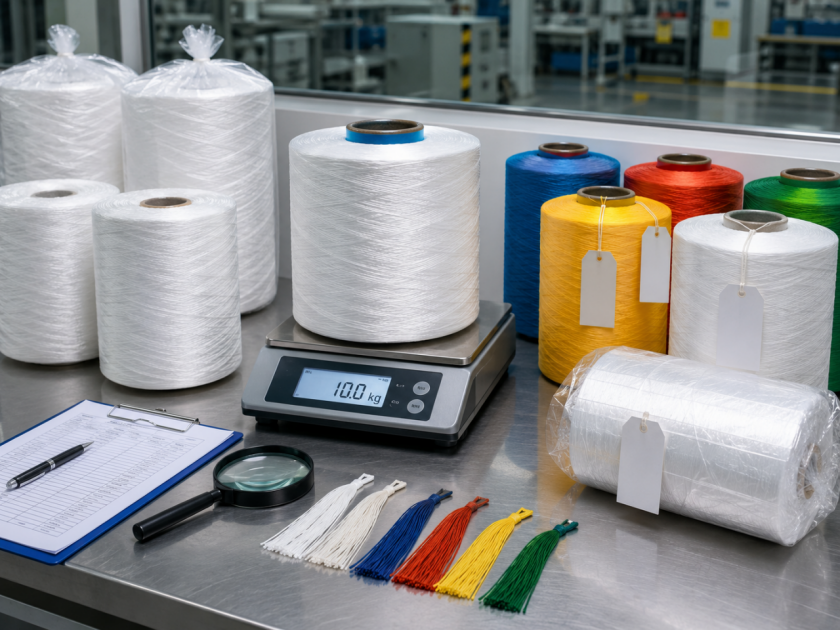
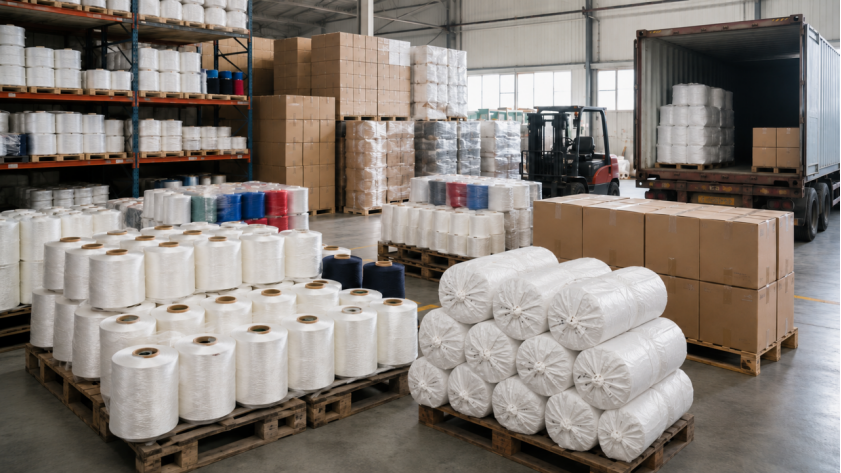
| Typical packing | About 10 kg per cone, 3 cones per bag; final packing confirmed by specification |
| Typical production lead time | About 10-15 days per container after specification, color and packing confirmation |
| Main applications | Rope, webbing, netting, sewing thread, industrial packaging and related textile production |
Commercial note: Lower denier specifications, especially below about 800D, may require different process control and may be priced differently. Final price also depends on color, tenacity, twist, intermingling, package weight, quantity and packing.
Regular, Air-Intermingled and Twisted PP Yarn
1. Regular or Untwisted PP Multifilament Yarn
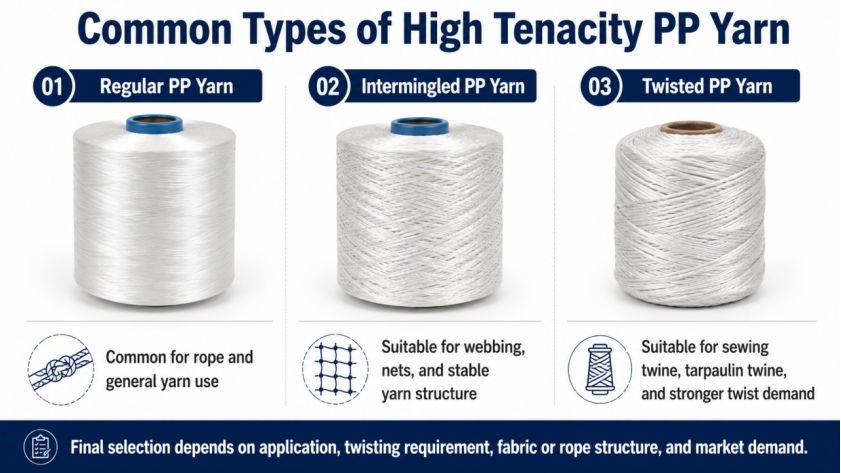
Regular yarn keeps the continuous filaments substantially parallel without an added twist level. It is commonly selected when the downstream customer will twist, braid, combine or process the yarn according to its own production requirements. Buyers should confirm filament cohesion and unwinding stability because loose filament separation can create feeding problems.
2. Air-Intermingled PP Multifilament Yarn
Air-intermingled yarn uses compressed air to create distributed interlacing points between filaments. This improves filament cohesion without applying a full mechanical twist. It can be useful for webbing, netting and other processes where the yarn needs more stability during feeding. Buyers should confirm the required intermingling level because insufficient or excessive interlacing can affect downstream processing.
3. Twisted PP Multifilament Yarn
Twisted yarn has a specified twist level, normally expressed in turns per metre (TPM). Twist can improve cohesion, handling and resistance to filament spreading, but excessive twist may change yarn diameter, elongation, surface feel and processing efficiency. The required TPM and S or Z direction should be confirmed before production.
BISFA defines twist level as the number of turns per unit length of a twisted yarn and notes that filament yarns may be flat, interlaced, twisted, twistless or textured. This terminology is useful when buyers compare quotations that use different descriptions for similar yarn forms.
Applications in Rope, Webbing, Netting and Industrial Textiles
Rope Manufacturing
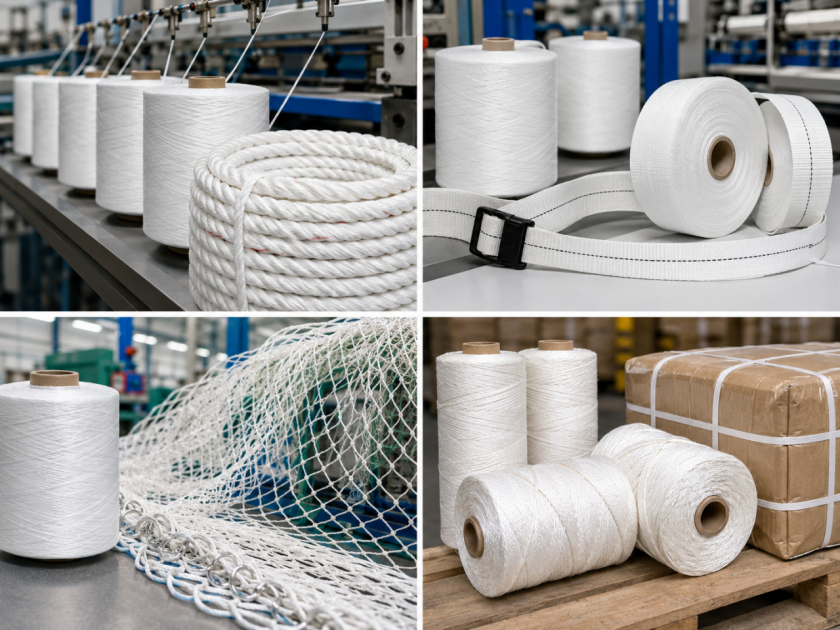
High tenacity PP multifilament yarn can be twisted, braided or combined into rope structures. The correct denier depends on finished rope diameter, strand construction, target weight, strength requirement and surface feel. For finished products, buyers can review our PP twisted rope and PP braided rope pages to understand typical downstream applications.
Related OKAY products: PP twisted rope and PP braided rope.
Webbing Production
For webbing, yarn feeding stability, color consistency, filament cohesion and package unwinding are important. Air-intermingled or appropriately twisted yarn may be preferred depending on loom type and fabric structure. The customer should confirm yarn count, number of ends, fabric width, target weight and strength requirement before selecting yarn.
Netting
Net production may require stable yarn feeding and suitable knotting or weaving behavior. Denier, twist, intermingling and finish should be matched to the net structure, mesh size and application. A yarn that works well in rope production may not automatically be the best choice for a specific net machine.
Sewing Thread and Industrial Packaging
Twisted PP multifilament yarn can be considered for sewing, tarpaulin and industrial packaging applications when the required twist, strength, color and package format are confirmed. The buyer should state the machine, seam or product requirement rather than ordering only by denier.
How to Choose PP Yarn Before a Bulk Order
1. Confirm the finished product
Tell the supplier whether the yarn is for twisted rope, braided rope, webbing, netting, sewing thread or another product. The same denier may require different twist, intermingling and package forms for different machines.
2. Confirm denier and tolerance
Specify the nominal denier and any acceptable tolerance. Do not use visual thickness as the only acceptance method. Linear density should be checked by mass per unit length.
3. Confirm tenacity and breaking force
State the required tenacity unit, such as g/den or cN/tex, and whether the requirement applies to white or colored yarn. Ask for the test method and batch result if strength is a critical purchasing point.
4. Confirm elongation
Breaking force alone does not describe how the yarn behaves under load. Elongation affects processing, finished rope stretch, webbing performance and machine settings.
5. Confirm twist or intermingling
For twisted yarn, confirm TPM and twist direction. For air-intermingled yarn, confirm the required cohesion or interlacing level and evaluate a sample on the customer’s machine.
6. Confirm color and UV requirement
Colored yarn can have different strength targets from white yarn. Provide a Pantone number or physical color sample when color matching is important. For outdoor use, state the expected sunlight exposure and whether UV-stabilized material is required.
7. Confirm package and unwinding
Cone weight, tube dimensions, winding tension, package shape and protective packing affect handling and machine feeding. Buyers should confirm whether standard 10 kg cones and 3-cone bags fit their warehouse and production line.
8. Confirm quantity, destination and delivery plan
Provide the quantity by specification and color, target delivery date, destination port and any pallet or container requirement. This helps the supplier prepare a more accurate quotation and production plan.
Quality Control and Test Points for factory Buyers
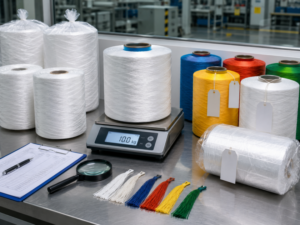
A useful yarn specification should connect commercial terms with measurable test points. The ISO 2062 breaking-force and elongation method describes determination of single-end breaking force and elongation at break using a constant-rate-of-extension tester. This is more reliable than comparing yarn only by hand pulling or visual inspection.
| Checkpoint | Why It Matters | What to Confirm |
| Linear density | Confirms whether actual yarn mass per length matches the nominal denier | ISO 2060-style skein or agreed package-yarn method |
| Tenacity | Compares strength relative to yarn size | Report in g/den or cN/tex with test conditions |
| Breaking force | Shows force at yarn break | Single-end yarn test under agreed conditions |
| Elongation at break | Shows extension before rupture | Important for processing and final product behavior |
| Twist / intermingling | Controls filament cohesion and processing behavior | TPM and direction for twisted yarn; agreed interlace level for air-intermingled yarn |
| Color consistency | Reduces shade variation between batches | Approved sample, Pantone or physical standard |
| Cone weight and winding | Affects inventory, handling and machine feeding | Net weight, tube size, winding shape and unwinding test |
| Packing | Protects yarn from contamination and transport damage | Bag, carton, pallet and label confirmation |
BISFA terminology is also useful for contract language because it defines terms such as multifilament yarn, tenacity, linear density, twist level and nominal linear density. Using the same terminology reduces misunderstandings between buyers, factories and testing laboratories.
Common Problems OKAY Helps factory Customers Avoid
| Buyer Problem | Possible Result | How OKAY Helps |
| Ordering only by denier | Correct nominal size but unsuitable strength, twist or processing behavior | Confirm denier, tenacity, elongation, yarn form and final application together |
| Confusing denier with finished diameter | Incorrect expectation for rope or webbing thickness | Use denier as linear density and confirm the downstream construction separately |
| Using one strength requirement for every color | Colored yarn may fail the buyer’s assumed target | Confirm white and colored yarn strength targets separately |
| No TPM or intermingling requirement | Filament spreading, unstable feeding or unsuitable hand feel | Confirm regular, air-intermingled or twisted form and approve a sample |
| Ignoring cone and tube dimensions | Package does not fit creel, storage or handling system | Confirm cone weight, tube size, winding and package dimensions |
| Only comparing price per kilogram | Lower price but unstable denier, strength or color across batches | Compare measurable specification, usable production yield and consistency |
| No sample test on the customer’s machine | Bulk yarn creates weaving, braiding or twisting problems | Run sample or pre-production confirmation before mass order |
| Unclear packing and shipping plan | Bag damage, contamination, labeling errors or inefficient loading | Confirm bag, carton, pallet, label, quantity and destination before production |
Why Work With OKAY Rope & Net?
- Focused 600D-3000D range: The range covers commonly requested yarn sizes for rope, webbing, netting and industrial textile applications.
- Specification matching: We help customers connect denier, strength, twist, intermingling, color, packing and application instead of quoting only a generic product name.
- White and colored strength targets: Separate strength targets help buyers understand that pigment and formulation can affect yarn performance.
- Customization support: Denier, color, twist, intermingling and package requirements can be discussed according to the customer’s machine and finished product.
- Sample and pre-production confirmation: Samples help customers evaluate unwinding, color, hand feel and machine compatibility before bulk production.
- Batch-focused quality communication: Useful checkpoints include denier, tenacity, elongation, color, cone weight, winding and packing consistency.
- Export-oriented packing and communication: Typical cone and bag packing, labeling, quantity, destination port and delivery details are confirmed before shipment.
- Manufacturing background since 2008: Shandong Okay Rope Net Co., Ltd. has long-term experience serving rope, twine and PP yarn customers in factory markets.
How We Work With PP Yarn Buyers
Step 1: Application review
Confirm the finished product, machine type, target market and required performance.
Step 2: Specification confirmation
Confirm denier, yarn form, tenacity, elongation, color, twist/intermingling and package.
Step 3: Quotation and sample
Provide a specification-based offer and prepare sample confirmation when required.
Step 4: Production and batch checks
Control the agreed yarn specification, color, cone weight, winding and packing.
Step 5: Packing and shipment preparation
Confirm bags, labels, pallets, container plan, destination port and delivery documents.
Step 6: After-sales communication
Support technical feedback and investigate specification or processing issues using sample and batch information.
FAQ
1. What is the difference between denier and tenacity?
Denier describes linear density or yarn size. Tenacity describes force divided by linear density. A higher denier yarn is heavier per unit length, but it is not automatically stronger on a strength-to-weight basis.
2. What PP yarn range can OKAY supply?
Our normal range is 600D-3000D, with regular, air-intermingled and twisted options. Final availability depends on color, strength, quantity and application.
3. What strength can you offer?
Our typical target is at least 6.5 g/den for white yarn and at least 5.5 g/den for colored yarn. The final requirement should be written into the quotation and confirmed by batch testing.
4. Which yarn is suitable for rope production?
The choice depends on rope diameter, braid or twist construction, strand count, target weight, strength and hand feel. Provide the finished rope specification or sample so the yarn can be matched more accurately.
5. Which yarn is suitable for webbing?
Webbing buyers should confirm denier, number of yarn ends, fabric width, target weight, strength, color, loom type and whether regular, intermingled or twisted yarn is required.
6. Can you match custom colors?
Yes, custom colors can be discussed. A Pantone reference or physical sample is recommended, and colored-yarn strength targets should be confirmed separately from white yarn.
7. What packing do you normally use?
A common configuration is about 10 kg per cone and 3 cones per bag. Tube size, cone weight, bag, carton, pallet and label requirements should be confirmed before production.
8. What information should I send for a quotation?
Please provide denier, color, yarn type, tenacity requirement, twist or intermingling requirement, cone weight, packing, quantity, application, destination port and sample requirement.
High tenacity PP multifilament yarn should be selected as an industrial input, not only as a commodity sold by kilogram. The correct choice combines nominal denier, actual linear density, tenacity, breaking force, elongation, twist or intermingling, color, package and downstream machine requirements.
OKAY Rope & Net supplies 600D-3000D PP multifilament yarn for rope, webbing, netting, sewing and industrial packaging applications. Our role is to help customers define the specification clearly, reduce processing problems, confirm samples and prepare stable export packing.
Review our high tenacity PP multifilament yarn range or contact OKAY Rope & Net for a factory quotation.